Updated AgilePM-Practitioner New Study Questions Provide Prefect Assistance in AgilePM-Practitioner Preparation
Wiki Article
P.S. Free & New AgilePM-Practitioner dumps are available on Google Drive shared by Lead2Passed: https://drive.google.com/open?id=1GYqBCpWHX3MwCPJZ7bq7OmdhvkSCgioY
Our Software version of AgilePM-Practitioner exam questions can carry on the simulation study, fully in accordance with the true real exam simulation, as well as the perfect timing system, at the end of the test is about to remind users to speed up the speed to solve the problem, the AgilePM-Practitioner Training Materials let users for their own time to control has a more profound practical experience, thus effectively and perfectly improve user efficiency, let them do it keep up on AgilePM-Practitioner exams.
APMG-International AgilePM-Practitioner Exam copyright Topics:
| Topic | Details |
|---|---|
| Topic 1 |
|
| Topic 2 |
|
| Topic 3 |
|
| Topic 4 |
|
>> AgilePM-Practitioner New Study Questions <<
AgilePM-Practitioner Exam Simulation: Agile Project Management (AgilePM) Practitioner Exam & AgilePM-Practitioner Training Materials
AgilePM-Practitioner offers free demo for AgilePM-Practitioner real test. You can check out the interface, question quality and usability of our AgilePM-Practitioner practice exams before you decide to buy it. You can download our AgilePM-Practitioner test engine and install it on your phone or other device, then if you are waiting for the bus or on the subway, you can take AgilePM-Practitioner Exam Dumps out for study. The promotion is regular, so please hurry up to get the most cost-effective APMG-International prep exam dumps.
APMG-International Agile Project Management (AgilePM) Practitioner Exam Sample Questions (Q153-Q158):
NEW QUESTION # 153
Midway through Project Increment 4, a joint Sprint Retrospective is held with Developers from both Delivery Teams.
Some members from Marketing and IT, based in India, join via video conferencing.
Issues raised:
. Dependency management challenges
Concerns about AgilePM principle ' Demonstrate Control '
To address this, Mira Bachar and the Developers invite Hira and Sukra Aroon to help Delivery Teams understand the issues, assess the consequences, and collaborate on solutions that align with AgilePM and Scrum.
In addition to the Developers, the teams include: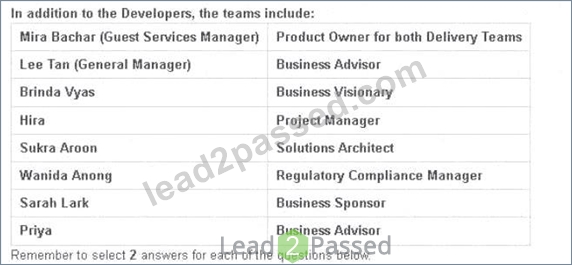
(Developers in the Infrastructure Team report integration issues between climate control and lighting systems, leading to an excessive energy demand beyond the capacity of the solar panels.
Which 2 of the following actions align with the AgilePM guidance on addressing risk?)
- A. Add integration testing to acceptance criteria for relevant Backlog items.
- B. Document all integration risks and have Sukra Aroon decide appropriate mitigation actions.
- C. Schedule integration workshops at the end of the all Sprints to address any integration concerns.
- D. Include explicit integration test scenarios in the Sprint Backlog.
- E. Extend the length of the Sprint to allow time to resolve integration issues.
Answer: A,D
Explanation:
The best answers are C and D .
C is correct because AgilePM promotes building quality and risk control into the work itself. Adding integration testing to acceptance criteria ensures that relevant items are not considered complete unless the integration risk has been addressed.
D is also correct because including explicit integration test scenarios in the Sprint Backlog makes the risk visible, actionable, and part of planned delivery rather than something left vague or deferred.
Why the others are weaker:
* A is not AgilePM-aligned because timeboxes should not be casually extended.
* B is too centralized; Sukra's input matters, but risk handling should be collaborative and embedded in delivery.
* E is too late and reactive; integration concerns should be addressed continuously, not saved for the end.
So the correct answers are C, D .
NEW QUESTION # 154
As Project Increment 4 progresses, the project team must choose the MOST effective communication methods for internal and external stakeholders. The Power/Interest Grid, created in the Foundations phase, is updated as needed when stakeholder influence or interest changes.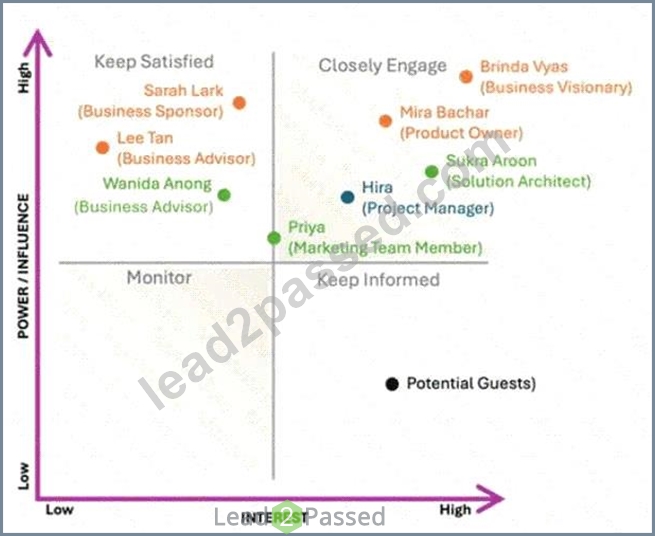
For each scenario in Column 1, select the MOST effective communication method from Column 2 to ensure successful outcomes and minimize risk of failure. Each selection in Column 2 can either be used once only or not at all.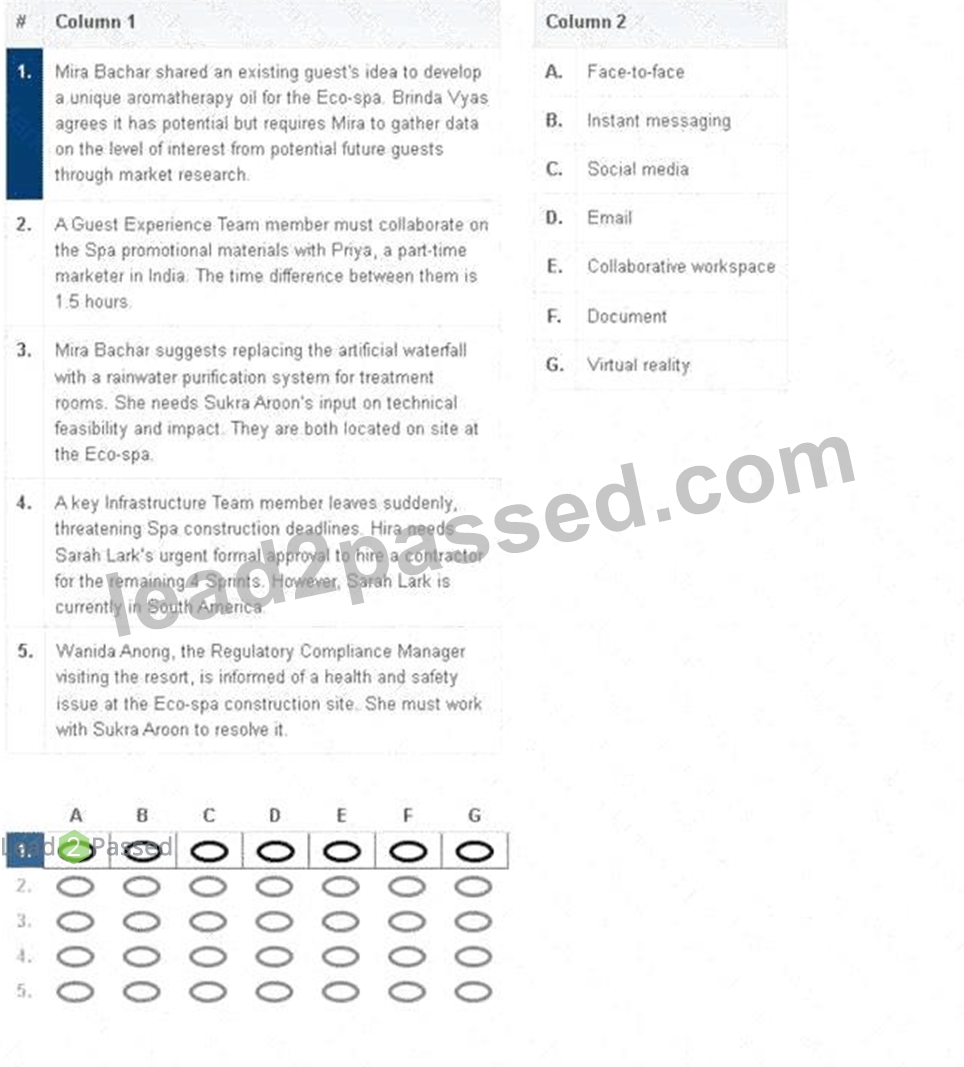
Answer:
Explanation: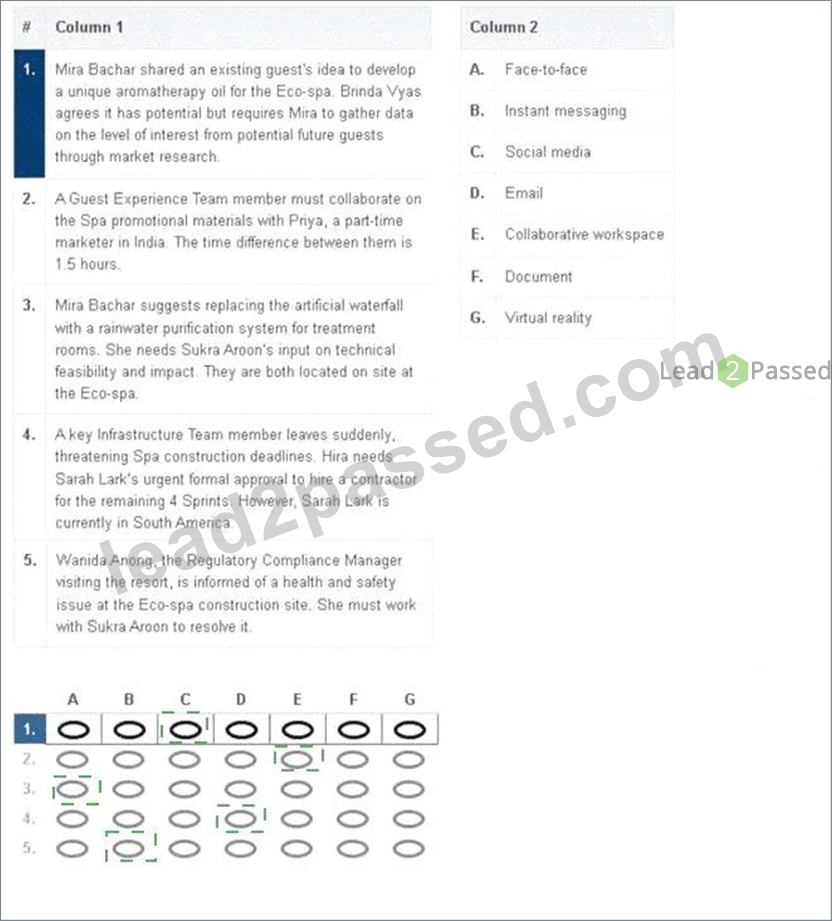
Explanation:
The best matching is:
1 # C (Social media)
2 # E (Collaborative workspace)
3 # A (Face-to-face)
4 # D (Email)
5 # B (Instant messaging)
Now the AgilePM reasoning for each:
1. Mira wants to gather interest from potential future guests for a unique aromatherapy oil Best answer: C. Social media This is the most effective option because the audience is potential future guests , who are external stakeholders with relatively low power but useful market influence. Brinda wants market research on likely interest, so the communication method should reach a broad audience efficiently and allow feedback collection at scale.
Why this fits AgilePM:
* AgilePM values timely feedback from stakeholders and users .
* Social media is highly suitable for testing interest, gathering reactions, and validating assumptions quickly.
* It helps support business value decisions before investing further.
Why others are weaker:
* Face-to-face is too limited in reach.
* Email is too narrow and inefficient for market testing.
* Document or collaborative workspace are internal tools, not ideal for external mass engagement.
2. A Guest Experience Team member must collaborate with Priya in India on promotional materials Best answer: E. Collaborative workspace This is the best method because the task involves co-creating content , likely with revisions, comments, versions, and shared visibility across time zones. Since Priya is part-time and there is a 1.5-hour time difference , a collaborative workspace supports both synchronous and asynchronous work.
Why this fits AgilePM:
* AgilePM encourages effective collaboration and visibility of work .
* A collaborative workspace allows both people to:
* edit shared materials,
* review updates,
* track changes,
* reduce version confusion,
* and keep progress transparent.
Why not email:
* Email creates fragmented threads and version-control issues.
* It is not the best tool for iterative collaboration on shared promotional assets.
3. Mira needs Sukra's input on replacing the waterfall with a rainwater purification system; both are on site Best answer: A. Face-to-face This is the strongest choice because the discussion involves technical feasibility, impact, and likely trade- offs , and both people are physically present at the Eco-spa. A face-to-face discussion gives the richest communication and allows rapid clarification.
Why this fits AgilePM:
* AgilePM favors direct communication where possible , especially for complex or potentially ambiguous topics.
* Technical and business conversations benefit from immediate back-and-forth discussion.
* Being on site means they may also inspect the actual area together, which reduces misunderstanding.
Why others are weaker:
* Instant messaging is less rich for a nuanced design/feasibility discussion.
* Email is too slow and formal for a collaborative on-site decision.
* Documenting the outcome may happen later, but the most effective method for the discussion itself is face-to-face.
4. Hira needs Sarah's urgent formal approval to hire a contractor; Sarah is in South America Best answer: D. Email This is the best answer because the communication need is both urgent and formal . Sarah is remote, and Hira needs a clear, traceable approval for hiring a contractor for the next four Sprints.
Why this fits AgilePM:
* AgilePM values communication that is fit for purpose .
* Since this is a sponsor decision with governance and approval implications, email provides:
* a formal record,
* clear wording,
* accountability,
* and easy reference later.
Why not instant messaging:
* Instant messaging may be faster, but it is less suitable for formal approval that may need auditability and clarity.
* For sponsor-level decisions affecting budget/resources, traceability matters.
5. Wanida identifies a health and safety issue on site and must work with Sukra to resolve it Best answer: B. Instant messaging This is the most effective option because the issue is urgent, operational, and time-sensitive . Even if both are on or around the resort, instant messaging enables rapid contact, immediate coordination, and quick sharing of updates while they move between locations.
Why this fits AgilePM:
* AgilePM supports fast, responsive communication when risks or blockers emerge.
* A health and safety issue requires quick coordination to minimize impact and prevent escalation.
* Instant messaging is practical for immediate action, especially on an active site.
Why not face-to-face here:
* Face-to-face is rich, but in this matching set it is better used for the complex solution discussion in scenario 3.
* For scenario 5, the key need is speed of coordination around an urgent site issue.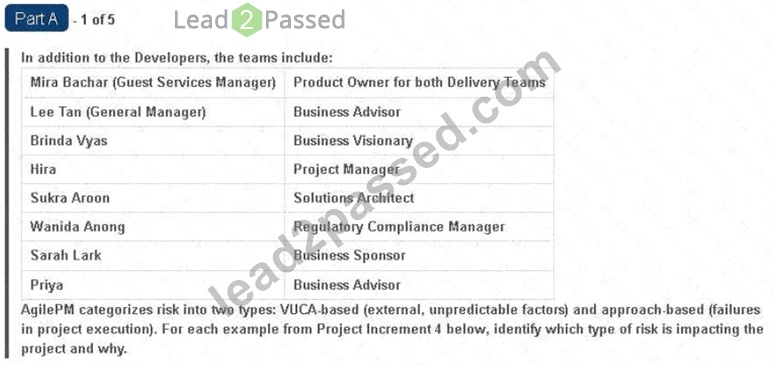
NEW QUESTION # 155
Using the Project Scenario and the additional information provided for
this question in the Scenario Booklet, answer the following questions
about Feasibility.
Remember to limit your answers to the number of selections requested in each question.
Which 2 statements describe the appropriate application of Agile Project Management when developing the Delivery Plan?
- A. The Architecture Angels' Marketing Director should be involved in the development of the Delivery Plan.
- B. The Earth Excavations' Head Gardener should be excluded from discussions related to deliverables since contracts are NOT yet signed.
- C. The Project Manager should include any known constraints associated with planning permission.
- D. The Project Manager should NOT need to identify any risks this early in the project.
- E. The approach to the project should be based on the Project Approach Questionnaire responses.
Answer: A,C
Explanation:
In the context of Agile Project Management, when developing the Delivery Plan during the Feasibility phase, the two statements that best align with Agile principles are:
A: The Project Manager should include any known constraints associated with planning permission.
E: The Architecture Angels' Marketing Director should be involved in the development of the Delivery Plan.
Here's the rationale:
*A: Recognizing and accounting for known constraints such as planning permission is a key aspect of Agile.
It allows for better adaptability and planning around these constraints. Including them early in the Delivery Plan helps ensure that they are considered throughout the project.
*E: Agile emphasizes cross-functional collaboration and stakeholder engagement. The Marketing Director would provide valuable insights into customer needs and market conditions, which are crucial for a successful delivery plan.
NEW QUESTION # 156
Sales staff are unhappy that they have been told that they will lose the Sales relaxation area completely to make space for the new Selco staff. The Sales staff are considering consulting their Union about escalating their discontent.
Which 2 actions by the Sales Director are the MOST appropriate when responding to this type of resistance?
- A. Delay information on the impact of the Selco relocation on Sales staff until just before the relocation move occurs.
- B. Arrange joint workshops for Sales and Selco staff to develop ideas and comment on layout options.
- C. Organize a Sales discussion group to look at alternative relaxation facilities that could be provided to the Sales staff.
- D. Exert pressure on the Sales management team to make sure any resistance is kept 'quiet'.
- E. Provide a farewell gathering in the relaxation area to enable staff to remember past stories about the area.
Answer: B,C
Explanation:
Comprehensive and Detailed Step-by-Step Explanation:
Context from the UniCo Scenario:
The Sales staff feel their working environment is being disrupted due to the integration of Selco staff. The loss of their relaxation area has led to discontent and potential escalation through their Union. Addressing this resistance requires creating opportunities for engagement, collaboration, and exploring alternatives to ensure both parties feel valued in the change process.
Analysis of Each Option:
* A. Arrange joint workshops for Sales and Selco staff to develop ideas and comment on layout options.
* Why Correct: Joint workshops encourage collaboration and allow both Sales and Selco staff to voice their concerns and contribute to finding a mutually beneficial solution. This action aligns with AgilePM's focus on building engagement and transparency in managing resistance.
* B. Delay information on the impact of the Selco relocation on Sales staff until just before the relocation move occurs.
* Why Incorrect: Withholding information undermines transparency, erodes trust, and increases resistance. AgilePM promotes early communication and engagement to prevent escalation of issues.
* C. Exert pressure on the Sales management team to make sure any resistance is kept 'quiet'.
* Why Incorrect: Suppressing resistance is counterproductive and creates further mistrust.
AgilePM encourages open dialogue to address resistance constructively rather than avoiding or silencing it.
* D. Provide a farewell gathering in the relaxation area to enable staff to remember past stories about the area.
* Why Incorrect: While this action acknowledges staff sentiment, it does not address the root cause of resistance or provide a tangible solution to the problem. AgilePM emphasizes taking practical steps to remove barriers to acceptance.
* E. Organize a Sales discussion group to look at alternative relaxation facilities that could be provided to the Sales staff.
* Why Correct: A discussion group allows Sales staff to explore alternative solutions collaboratively. It helps them feel involved and valued in the process, reducing resistance and aligning with AgilePM's principle of stakeholder engagement.
Why A and E Are Correct:
* Workshops (A):
* Promote collaboration and shared ownership of the solution, reducing conflict and building trust between Sales and Selco staff.
* Discussion Groups (E):
* Provide an avenue for Sales staff to voice their concerns and explore practical alternatives, demonstrating that their input is valued.
References to AgilePM Framework:
* Stakeholder Engagement and Transparency:
* Encouraging open dialogue and shared decision-making reduces resistance. (AgilePM Practitioner Guide, Chapter 8: Stakeholder Engagement)
* Collaborative Problem-Solving:
* Using workshops and discussion groups aligns with AgilePM's focus on fostering collaboration and trust during change. (AgilePM Practitioner Guide, Chapter 6: Facilitating Change)
* Addressing Resistance:
* AgilePM emphasizes understanding the root causes of resistance and actively involving stakeholders in solutions. (AgilePM Practitioner Guide, Chapter 10: Preparing for Change)
NEW QUESTION # 157
Two Sales staff members appear to have lost energy for the change process and did not attend recent change meetings. When questioned, they said they were so overwhelmed by the number of changes in systems, materials, technical knowledge, and processes that they couldn't deal with any more.
Which 2 actions by the Sales Director are the MOST appropriate when responding to this type of resistance from staff?
- A. Ensure these staff members are rewarded for raising issues with the implementation.
- B. Add personal staff targets to ensure that the changes in the sales operations are continued.
- C. Assign the staff members to projects outside of this change, to prevent them undermining the changes needed.
- D. Find out which elements could remain unchanged so that future sales are unaffected.
- E. Consider limiting the changes to those that are related to each other during each iteration of change in sales.
Answer: D,E
Explanation:
Comprehensive and Detailed Step-by-Step Explanation:
1. Analysis of the Scenario: The staff members are experiencing change fatigue due to the overwhelming number of adjustments in systems, processes, and technical knowledge. This fatigue often arises during significant organizational transformations like the one UniCo is undergoing, where staff members feel unprepared or unsupported to handle multiple changes.
Agile Project Management (AgilePM) emphasizes adaptive change management, where incremental changes are planned and staff are supported throughout transitions. The Agile approach also recommends prioritizing manageable changes to prevent burnout.
2. Option Evaluation:
A: Find out which elements could remain unchanged so that future sales are unaffected.
* Explanation: Maintaining some consistency during the change process can help overwhelmed staff feel less stressed. By preserving elements that do not directly need alteration, employees can focus on critical areas that need improvement without feeling they are losing their entire work foundation.
* Reference from AgilePM: Agile emphasizes incremental delivery and the need to protect stability where possible during change efforts. This is key to balancing innovation with operational continuity.
* Why Correct: This approach reduces unnecessary change and helps staff focus on priority areas, reducing resistance and fatigue.
B: Add personal staff targets to ensure that the changes in the sales operations are continued.
* Explanation: While setting targets can be a motivational tool, introducing personal targets during a period of resistance or overwhelm can exacerbate stress and lead to further disengagement.
* Why Incorrect: AgilePM advocates for team empowerment and reducing pressure during resistance phases. Adding personal targets does not address the root cause of change fatigue.
C: Assign the staff members to projects outside of this change, to prevent them undermining the changes needed.
* Explanation: Removing staff from the process entirely may appear to prevent further resistance, but it also excludes them from adapting to and learning the new processes. Such an action can lead to further disengagement and even attrition.
* Why Incorrect: AgilePM encourages collaboration and engagement rather than sidelining staff during organizational changes.
D: Consider limiting the changes to those that are related to each other during each iteration of change in sales.
* Explanation: By grouping related changes, staff can focus on cohesive elements rather than being overwhelmed by disjointed changes. This iterative approach aligns with AgilePM principles, which emphasize breaking down tasks into smaller, manageable chunks.
* Reference from AgilePM: The iterative and incremental approach in Agile ensures that teams manage workload effectively while focusing on high-priority changes.
* Why Correct: Limiting and organizing changes into related areas ensures clarity, reduces cognitive load, and builds confidence among the sales staff.
E: Ensure these staff members are rewarded for raising issues with the implementation.
* Explanation: Rewarding staff for raising concerns is a positive reinforcement tactic. However, it does not address the root issue of change fatigue. While this could encourage openness, it does not reduce the overwhelming workload or clarify processes.
* Why Incorrect: Although AgilePM emphasizes transparency, this approach does not mitigate the resistance caused by change overload.
3. Final Recommendation:
* Correct Actions: A and D effectively address the root causes of resistance (overwhelm and fatigue) by maintaining stability where possible and grouping related changes into iterations.
* These solutions align with AgilePM's focus on iterative change, manageable workloads, and staff engagement.
* Incorrect Actions (B, C, E): These options either fail to address the root problem or risk disengagement further.
References:
* AgilePM Practitioner Guide, Chapter on Stakeholder Engagement and Managing Change.
* AgilePM Principles: Incremental Delivery and Focus on the Business Need.
* Agile Change Management Strategies for Overcoming Resistance.
NEW QUESTION # 158
......
Many candidates who are ready to participate in the APMG-International certification AgilePM-Practitioner exam may see many websites available online to provide resources about APMG-International certification AgilePM-Practitioner exam. However, Lead2Passed is the only website whose exam practice questions and answers are developed by a study of the leading IT experts's reference materials. The information of Lead2Passed can ensure you pass your first time to participate in the APMG-International Certification AgilePM-Practitioner Exam.
AgilePM-Practitioner Real Dumps: https://www.lead2passed.com/APMG-International/AgilePM-Practitioner-practice-exam-dumps.html
- 100% Pass-Rate AgilePM-Practitioner New Study Questions - Leading Offer in Qualification Exams - First-Grade APMG-International Agile Project Management (AgilePM) Practitioner Exam ???? Easily obtain free download of ( AgilePM-Practitioner ) by searching on ▶ www.vceengine.com ◀ ????AgilePM-Practitioner Reliable Test Materials
- Practice AgilePM-Practitioner Test Engine ???? AgilePM-Practitioner Valid Test Prep ???? Reliable AgilePM-Practitioner Exam Online ???? Easily obtain free download of ➥ AgilePM-Practitioner ???? by searching on 《 www.pdfvce.com 》 ????Valid AgilePM-Practitioner Test Cost
- Overcome Exam Challenges with APMG-International AgilePM-Practitioner Exam Questions ???? Search for 【 AgilePM-Practitioner 】 and obtain a free download on ✔ www.examcollectionpass.com ️✔️ ????Latest AgilePM-Practitioner Exam Tips
- AgilePM-Practitioner Reliable Test Materials ❔ Valid AgilePM-Practitioner Test Cost ???? Practice AgilePM-Practitioner Test Engine ???? Search for 「 AgilePM-Practitioner 」 and download exam materials for free through ▛ www.pdfvce.com ▟ ????AgilePM-Practitioner Valid Test Review
- Free PDF APMG-International - AgilePM-Practitioner - Authoritative Agile Project Management (AgilePM) Practitioner Exam New Study Questions ⛪ Search for ➥ AgilePM-Practitioner ???? and obtain a free download on ▛ www.dumpsquestion.com ▟ ????AgilePM-Practitioner Valid Test Review
- AgilePM-Practitioner Valid Test Prep ???? AgilePM-Practitioner Latest Dump ???? Unlimited AgilePM-Practitioner Exam Practice ???? Search for ➥ AgilePM-Practitioner ???? and download it for free immediately on ⏩ www.pdfvce.com ⏪ ????AgilePM-Practitioner Latest Cram Materials
- Updated AgilePM-Practitioner New Study Questions offer you accurate Real Dumps | Agile Project Management (AgilePM) Practitioner Exam ???? Search for ( AgilePM-Practitioner ) and download it for free on 《 www.prepawayexam.com 》 website ????Exam AgilePM-Practitioner Answers
- Overcome Exam Challenges with APMG-International AgilePM-Practitioner Exam Questions ???? Download ⮆ AgilePM-Practitioner ⮄ for free by simply searching on ▶ www.pdfvce.com ◀ ⏳Valid AgilePM-Practitioner Test Cost
- Practice AgilePM-Practitioner Test Engine ???? AgilePM-Practitioner Valid Test Review ✔️ AgilePM-Practitioner Latest Real Exam ???? Download ➥ AgilePM-Practitioner ???? for free by simply searching on ➽ www.pdfdumps.com ???? ????Valid AgilePM-Practitioner Test Cost
- Overcome Exam Challenges with APMG-International AgilePM-Practitioner Exam Questions ???? Search for [ AgilePM-Practitioner ] and download it for free on ➽ www.pdfvce.com ???? website ????AgilePM-Practitioner Reliable Test Materials
- copyright AgilePM-Practitioner Torrent ???? 100% AgilePM-Practitioner Accuracy ???? AgilePM-Practitioner Valid Test Review ⚛ Go to website ➠ www.prepawaypdf.com ???? open and search for ➠ AgilePM-Practitioner ???? to download for free ????AgilePM-Practitioner Simulations Pdf
- declanxjgj836482.blogdun.com, www.stes.tyc.edu.tw, hamzahdjvs303107.activoblog.com, liviavhyg352881.vigilwiki.com, www.stes.tyc.edu.tw, webcastlist.com, nikolasxxyd532949.ttblogs.com, bookmarkport.com, www.stes.tyc.edu.tw, mayaedmy951696.blogdun.com, Disposable vapes
What's more, part of that Lead2Passed AgilePM-Practitioner dumps now are free: https://drive.google.com/open?id=1GYqBCpWHX3MwCPJZ7bq7OmdhvkSCgioY
Report this wiki page